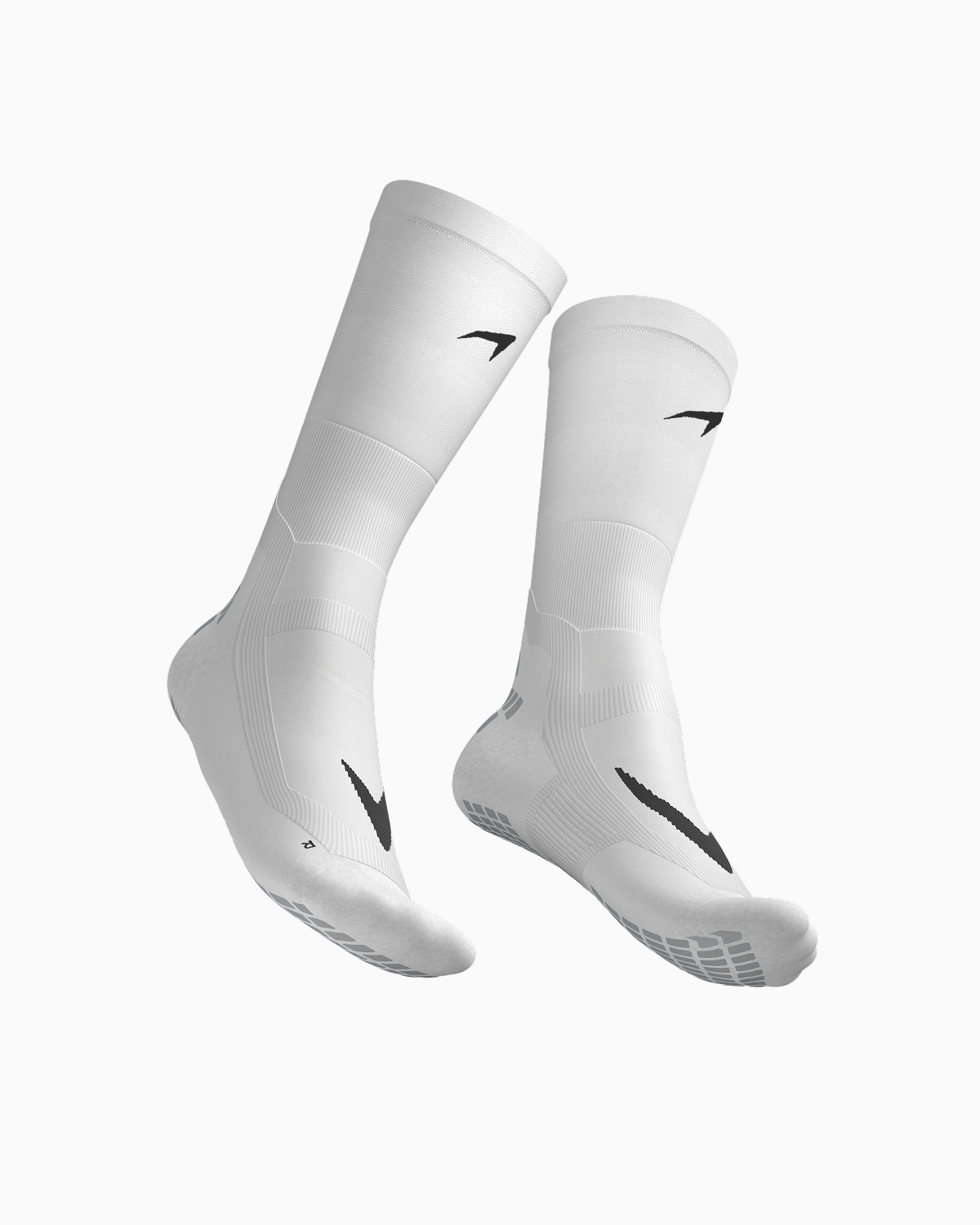
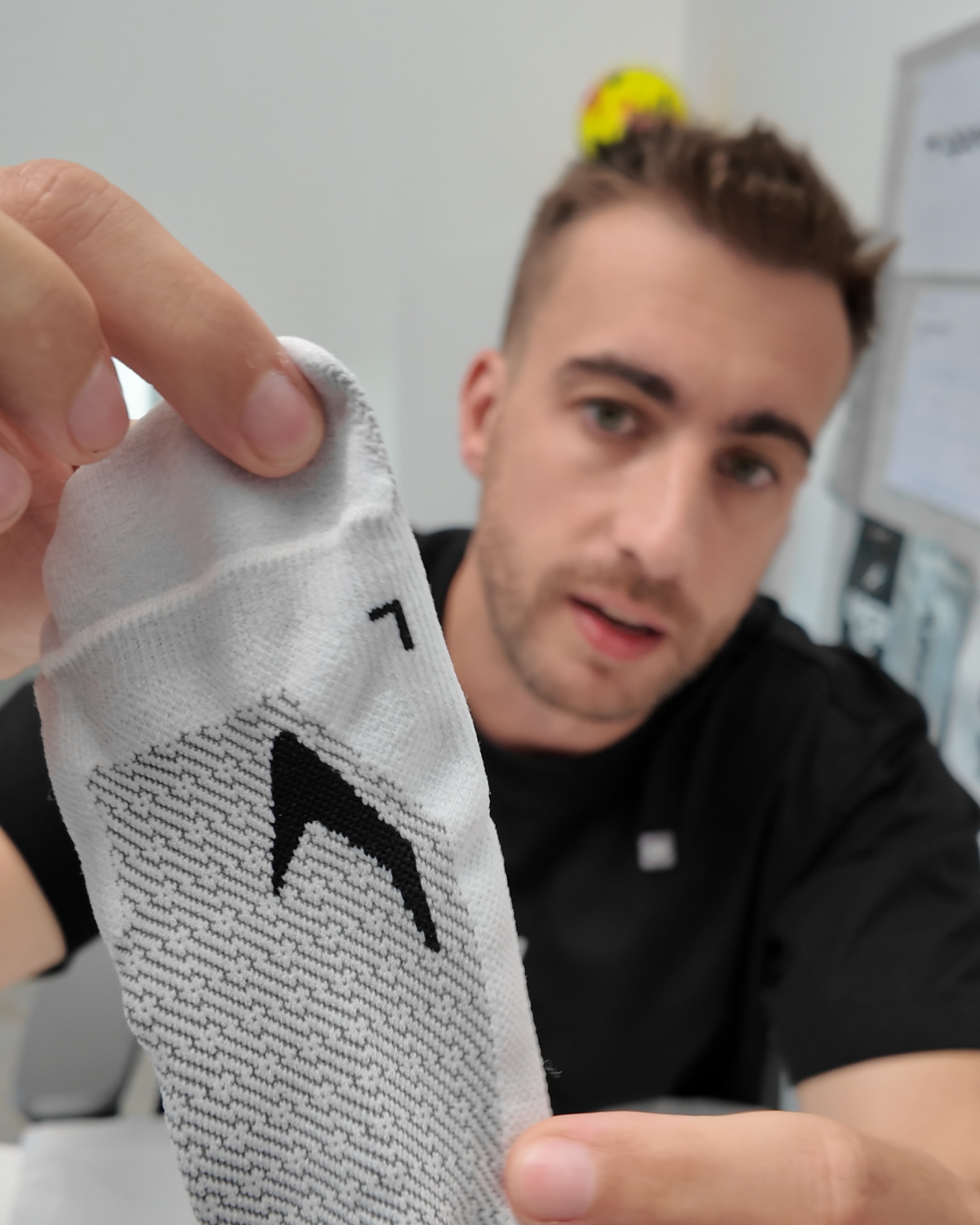

This one is somewhat controversial, but a topic I’ve got deeper and deeper into over the last 12 months. For years, the football sock category has been built around a very simple promise: if your foot moves inside your boot, grip will fix it.
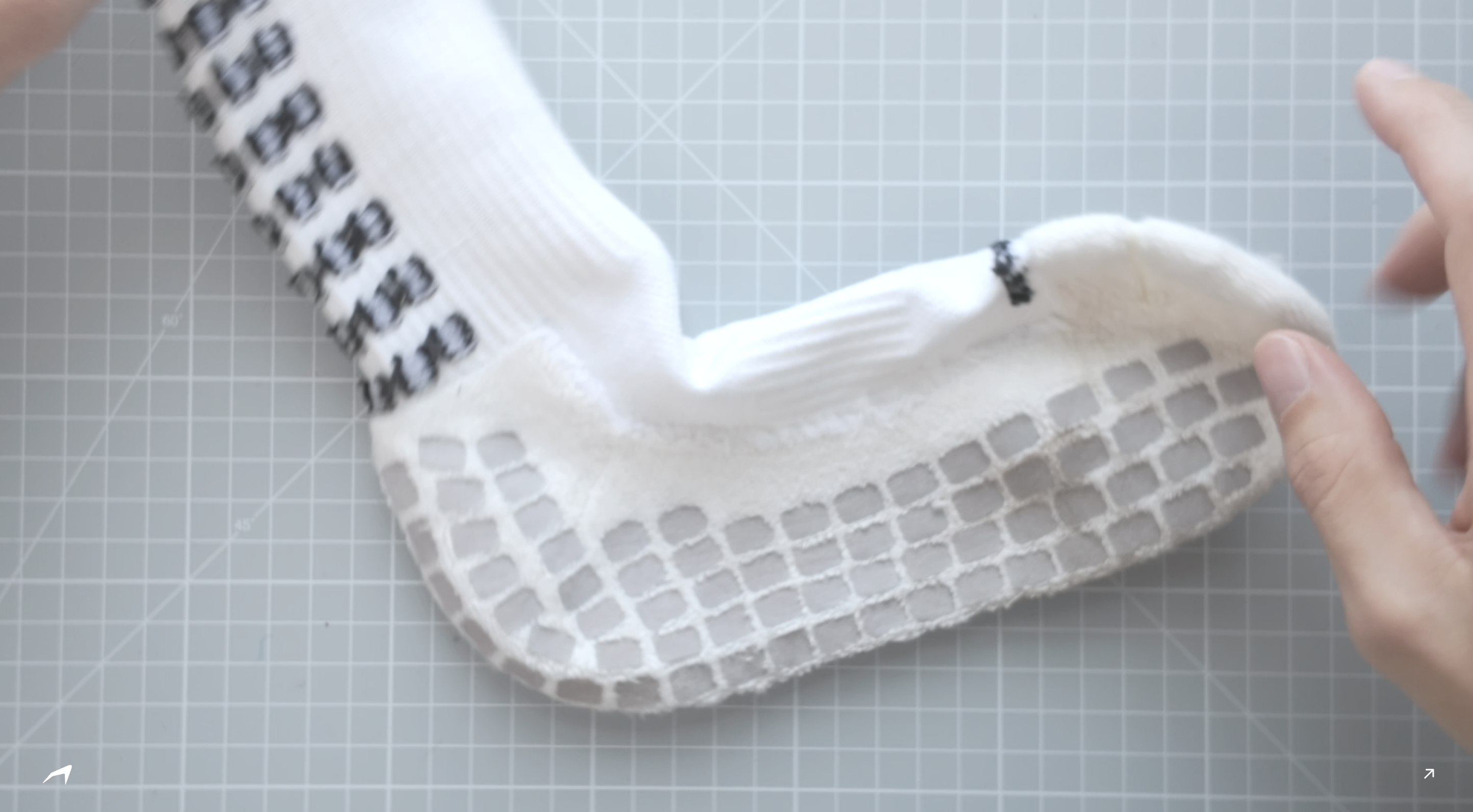
It’s an easy idea to understand and the logic feels obvious. If your foot slips, adding some rubber or silicone pads to the sock should do the trick. The sock feels grippy to touch, it looks somewhat technical and you assumes the problem has been solved.
But, the more time I spent studying the intricate relationship between the anatomically perfect foot, the vital sock layer, and the man-made synthetic boot, the more limited that thinking has started to look. Traditional grip pads are a crude solution to a very complex, biomechincally and neurally driven problem.
The fact is simple: the age of the ‘grip sock’ is over. However...
Like I said in a previous founder update, grip isn’t the foundation of a high-performance football sock. But, that doesn’t mean it’s irrelevant. Far from it, in fact. The problem is that grip has too often been treated as the whole solution. The whole product. And it led to years of lazy sock design.
Football socks are poor not because of poor grip - but a myriad of interconnected reasons. Moisture absorption. Compression. Structure. Arch support. Bunching. Hot spots. Neural noise. If these problems exist, grip pads are irrelevant. And, in a lot of cases, just make things worse.
Common grip materials like Silicone and Rubber are popular (yet awful) choices for many sock brands because they’re accessible, affordable, and easy to apply. I admit too they can feel pretty effective at first touch, especially in a clean/dry environment. But football isn’t a clean OR dry environment. It’s played inside a highly pressurised, sweat-driven environment.
The thing is, current grip pad tech that feels convincing when you first rip open the package at your front door may behave very differently after an hour of sweat or rain or repeated movement on the pitch. Poorly chosen grip becomes incredibly inconsistent. It can trap heat. It can create hot spots. It can add bulk underfoot where you actually need more sensitivity. It can interfere with the way the foot naturally bends and spreads under load if the grip is too rigid. And if the sock underneath is already a baggy, absorbent, badly structured floppy cotton (or polyester) tube, those grip pads are being asked to compensate for failures it was never designed to solve.
To make matters worse, a Silicone or Rubber grip actually gets slippier and less secure (reduced grip co-efficient) when your foot is wet or sweaty. So the very thing you wear to help fix slipping and movement ends up doing the exact opposite. It’s kinda insane.
Other materials bring different compromises. PU or Ultra Suede-style grips, for example, can offer durability and a distinct feel, but they can also be thick, stiff, and less able to move with the changing shape of the foot. That matters because the foot is not a flat object pressing down into a flat surface. It’s a bundle of nerves, fascia and muscle - reactive, and constantly adjusting. A grip layer that does not move with the foot can start to work against the connection it’s supposed to improve.
This is why I’ve become increasingly frustrated by the way (the grip part of) grip socks are made. The idea itself isn’t wrong, but the execution is just way too shallow.
When we made the PRO 3.0 sock, we thought hard about all this stuff. The combination of its DuraGrip and ExoFrame gave players a more secure fit, a way better structure and a stronger feeling of lockdown than pretty much any other grip socks on the market. It was a real step forward for Apex.
But there is a difference between making something better than the competition and building the best possible version of the product from first principles. The PRO 3.0 was designed to improve on the market. The ELITE-1 had to be designed around the elite player.
That is why, with the ELITE-1, we rebuilt the foundation first. UltraDri and Density+ gave us the base: a lighter, denser, more breathable structure that could hold the foot properly before any grip was added. Once that foundation was in place, we could begin developing a grip system that made sense within the wider architecture of the sock.
A material designed to be thermally adaptive to all conditions, microns thin, hyper-flexible, featherlight, structurally breathable, durable - and most importantly actively enhance the neural information between your feet and your brain. It’s space-grade tech.
CompoundX.
In the next founder update, I’ll take you inside how we built it, why it feels different, and why grip only becomes powerful when it is part of a complete performance system.
Coming Soon


Join The ELITE-1 Waitlist
- Early Access alongside our PRO players
- Guarantee Your Pair + Size (Only 3000 Pairs Available Worldwide)
- Exclusive Waitlist Launch Offers
- Behind-The-Scenes Updates + Giveaways
- Join the 2055+ Athletes in the Queue
ELITE-1 FOUNDER UPDATES
#1 You've Been Lied to By Grip Sock Companies
#3 What Pros Hate About Their Football Socks
#4 This Secret is the Future of Grip Socks
#5 We’re NOT Building a Grip Sock
#9 Internal Grip Pads Don’t Work. Here’s Why.