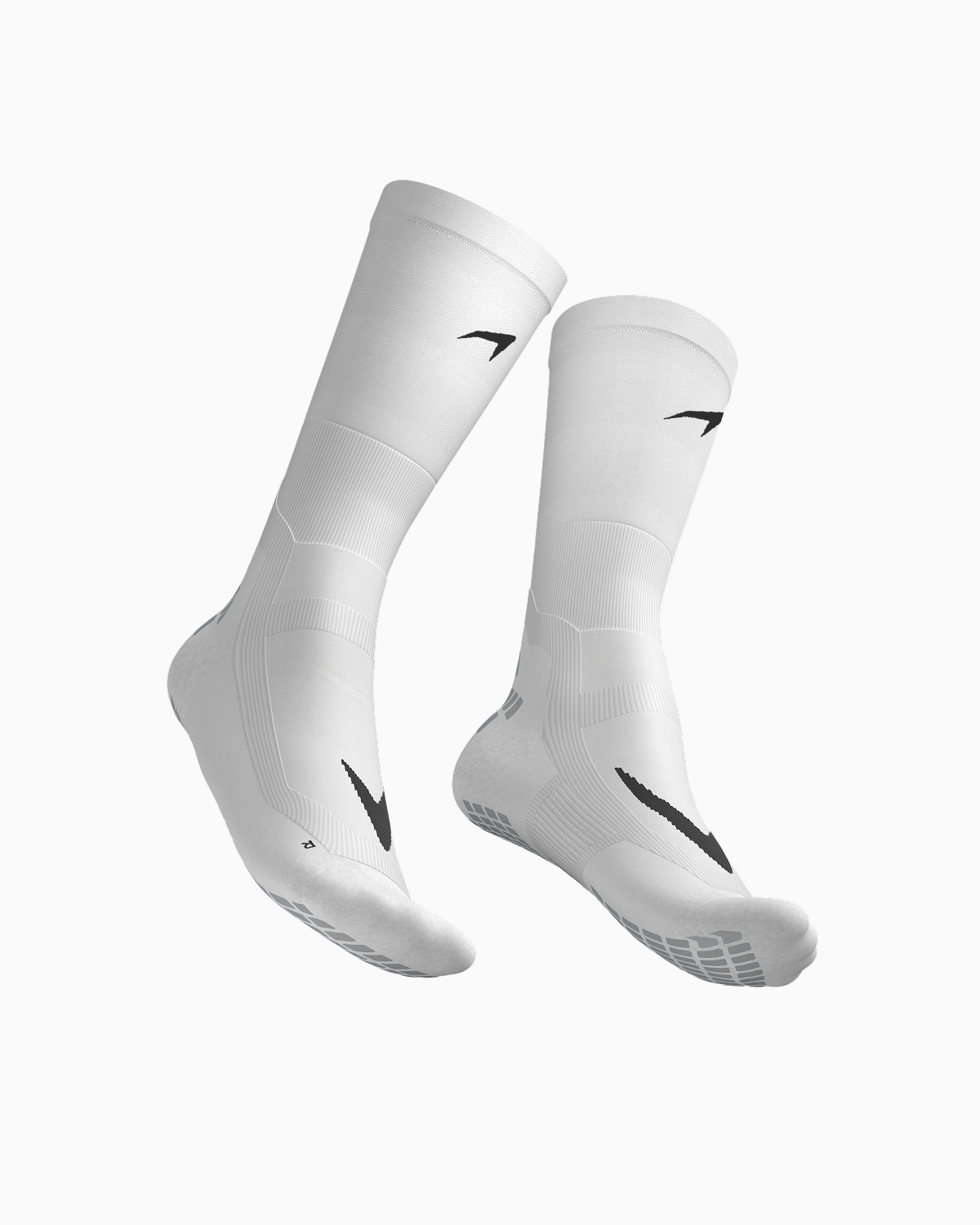
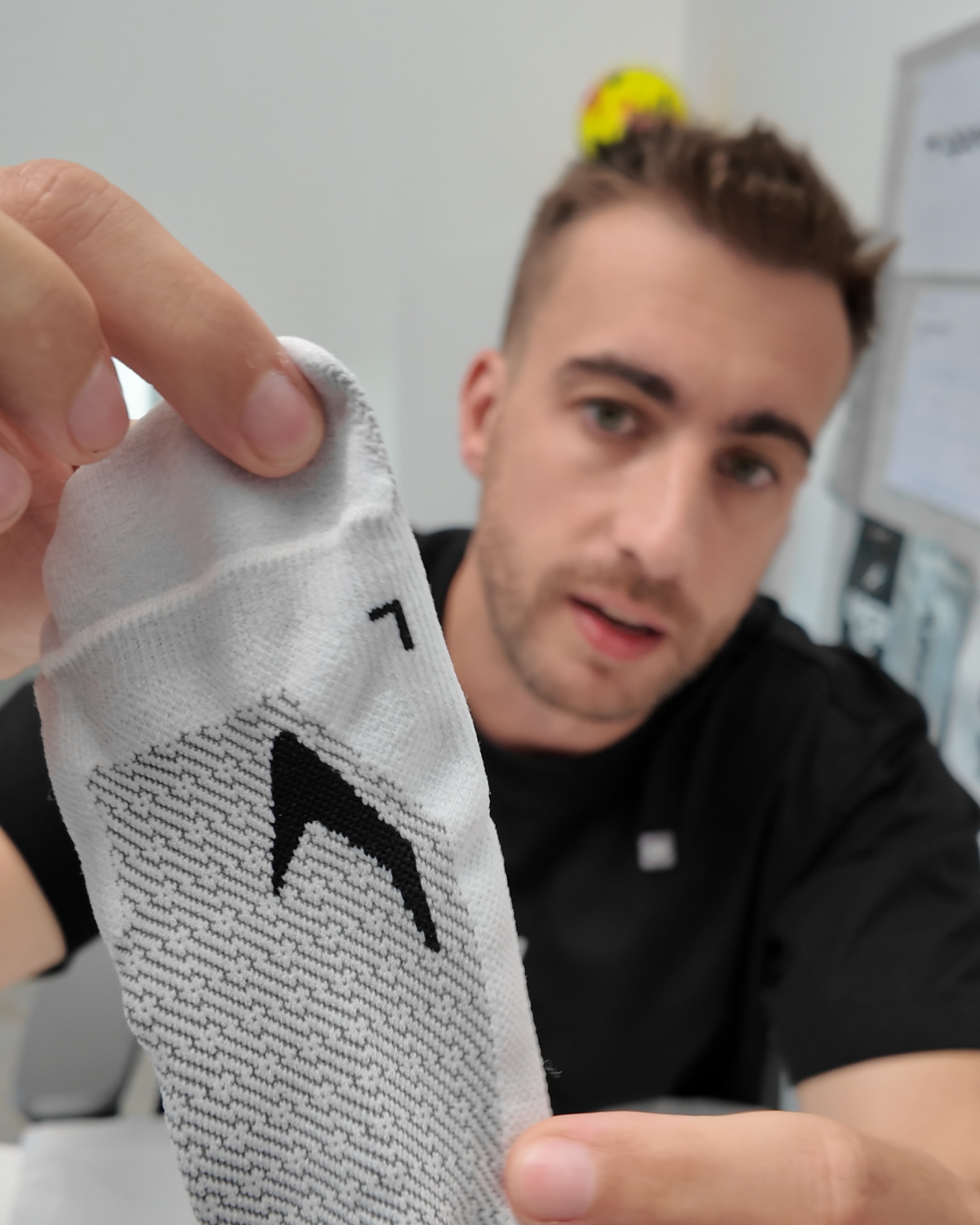


In the last update, I explained why grip socks have been built backwards.
For years, the category has treated ‘grip’ as the product. Add silicone, rubber, or ultra-suede to the bottom of a standard crew sock and assume the job is done. But once we rebuilt the foundation of the ELITE-1 with our 2nd-Gen ExoFrame (more on that soon), UltraDri material and Density+ cushioning the next question became far more interesting:
What should grip actually be when it’s no longer used to cover up the weaknesses of the sock underneath?
That question led us to CompoundX.
I don’t say this lightly, because it’s taken years of testing, failure, refinement, and obsessive detail to get here. But I genuinely believe CompoundX makes traditional grip socks feel instantly dated, because it solves the problem in a radically new way - and NOT just to give you more ‘grip’.
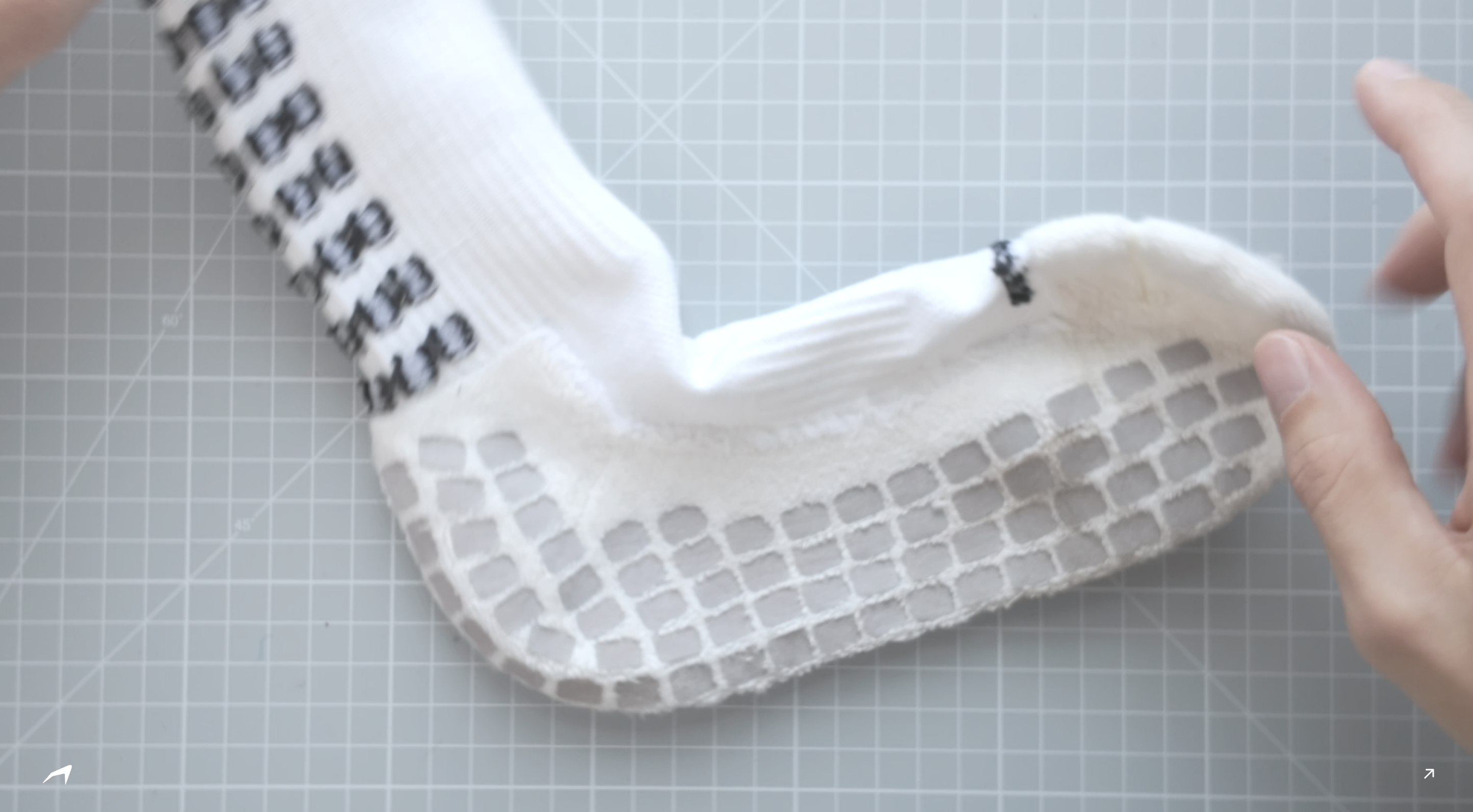
In short, CompoundX is our custom built grip compound, developed specifically for the demands of elite performance. I’m going to avoid giving away too much of the details that need to remain proprietary for obvious reasons, but the principle behind it is simple enough to explain: grip should not be stiff, bulky, sealed-off, or one-dimensional.
It should map to the foot. It should remain thin. It should flex under load. It should maintain breathability. It should adapt as conditions change. And it should give the player a cleaner, more consistent connection to - not only the boot - but the neural pathways between your feet and your brain.
Am I asking a lot. Yes. And that’s the whole damn point. For too long the industry has made cheap, poorly designed, and gimmicky solutions to vital knife-edge performance defining problems.
Our primary influence for CompoundX came from the natural world, where millions of years of evolution have quietly refined structures for strength, movement, grip, and efficiency. The hexagon appears again and again in places where strength and space need to coexist: honeycomb, cellular structures, reptile scales, insect eyes, and countless other natural surfaces. It’s both visually elegant and structurally useful. It creates depth without waste, stability without unnecessary mass, and resilience without complete rigidity. At a microscopic level, CompoundX is built around the same principle.
This the part I think makes CompoundX so different:
Most grip pads are static. They are pieces of material attached to the bottom of a sock, trying to create friction between fabric and insole. CompoundX is different because it behaves more like a responsive interface. It holds, compresses, flexes, and returns. It’s not there to just make the sock feel sticky. Instead, it’s there to improve the way force, movement, and information pass between the foot and the boot - back to your brain.
In football, we’ve never crossed that barrier before. Until now.
The foot is constantly changing shape inside the boot. It spreads under load, bends through the forefoot, rotates through turns, braces during contact, and pushes off again before the player has time to consciously think about any of it. Every movement asks the foot to stabilise, transfer force, and send information back to the brain. If the grip material underneath is too thick / rigid / flat / inconsistent, it affects comfort and destroys the quality of that connection.
This is why traditional grip pads have always felt limited to me. They try to solve one problem - slippage - by creating another set of compromises: bulk, heat, stiffness, pressure, reduced feel, or unpredictable performance once the boot gets warm and wet. CompoundX was developed to obliterate that trade-off.
This is why I think CompoundX is more than a new grip material. It’s a completely new connection layer. A way of making the foot feel more secure inside the boot without making the player more aware of the sock.
That’s a very difficult balance to achieve. And it’s why, as I said before, I believe CompoundX makes traditional grip socks feel instantly dated. Not because it creates a louder grip sensation when you first put it on, but because it changes what grip is actually capable of doing. It turns grip from a static feature into an active adaptive part of the performance system - much like your own skin.
There’s actually way more to the material than this that I’ll probably talk about over on @apexsox, where I’m sharing even more of the behind-the-scenes of the development process. But hopefully you get the point.
Of course, however, external grip is only one side of the problem.
A sock can grip the boot perfectly and respond perfectly underfoot, yet still fail if the foot is moving inside the sock. That second connection - between skin and fabric - is just as delicate, and very easy to get wrong.
And, as I’ll explain in the next founder update, this is where a lot of brands have made another critical mistake...
Coming Soon


Join The ELITE-1 Waitlist
- Early Access alongside our PRO players
- Guarantee Your Pair + Size (Only 3000 Pairs Available Worldwide)
- Exclusive Waitlist Launch Offers
- Behind-The-Scenes Updates + Giveaways
- Join the 2055+ Athletes in the Queue
ELITE-1 FOUNDER UPDATES
#1 You've Been Lied to By Grip Sock Companies
#3 What Pros Hate About Their Football Socks
#4 This Secret is the Future of Grip Socks
#5 We’re NOT Building a Grip Sock
#9 Internal Grip Pads Don’t Work. Here’s Why.